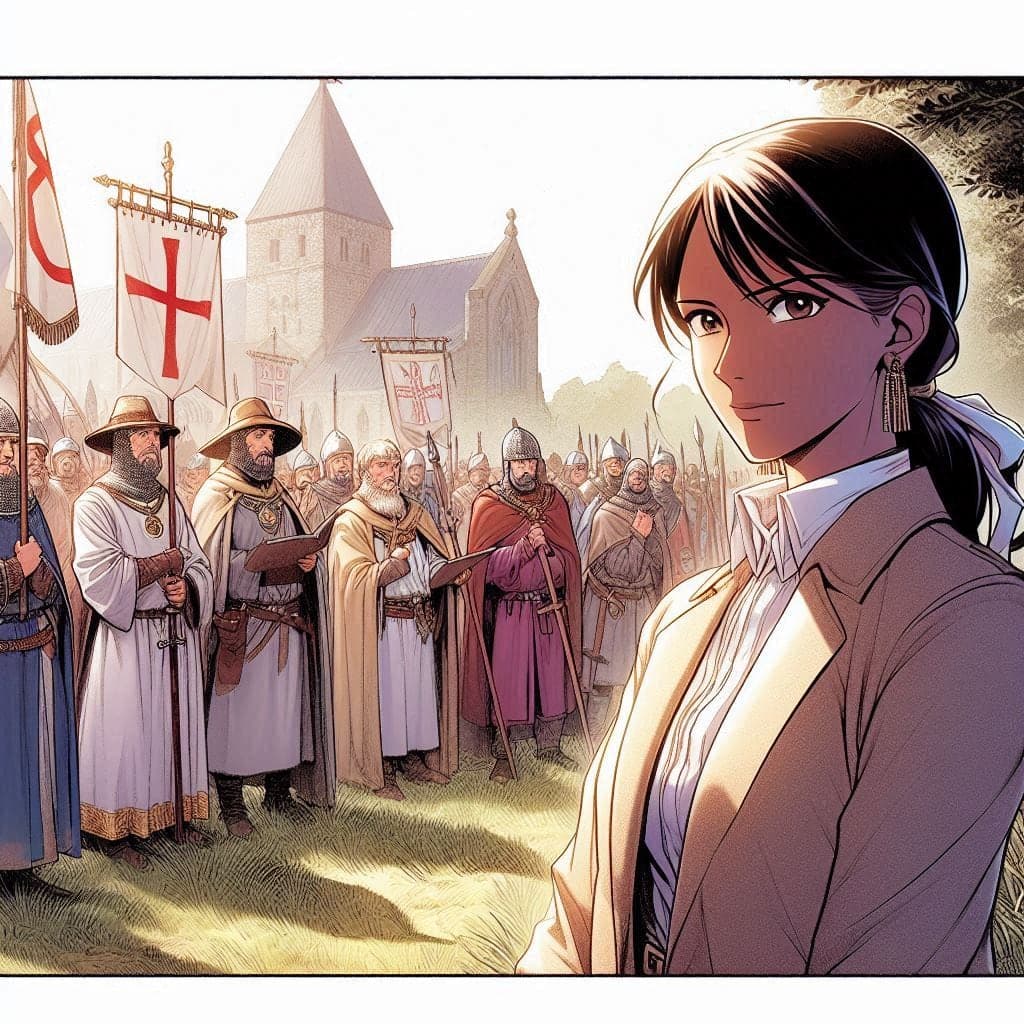
Back In The Field: Bury St Edmunds, Magna Carta & The Oath That Changed England!
Beginning of a New Chapter in a Town That Helped Shape The Rule of Law.
There are moments in life when history feels strangely personal. Recently, I began a new professional chapter in the historic town of Bury St Edmunds in Suffolk.
At first glance, it is a beautiful English market town filled with historical buildings, abbey ruins, a cathedral, gardens, and cafés. But beneath its quiet charm lies one of the most important legal and political stories in English history. A place deeply connected to the origin of the Rule of Law, Liberty, and ultimately the birth of the Magna Carta - "Great Charter."
And once I discovered the history, I realised that this was more than just a new workplace location. It felt symbolic.
Who Was St. Edmunds?
The town takes its name from Edmund the Martyr, a 9th-century Anglo-Saxon King of East Anglia.
According to historical accounts, Edmund was captured by Viking invaders in 869 AD and ordered to submit. He refused to renounce his catholic beliefs or surrender his principles by becoming a puppet king. He was executed and later venerated as a martyr.
Over time, his shrine became one of the most important pilgrimage destinations in Medieval England. Around it grew the great Abbey of Bury St Edmunds, one of the richest and most influential monasteries in the country.
But the abbey would become known for something even greater than religion. It would become linked to one of the earliest steps toward limiting the power of kings.
The Oath Signed in Bury St Edmund That Changed England
In 1214, a group of English barons gathered inside the Abbey of Bury St Edmunds.
Their grievance was King John of England, whose rule had become associated with excessive taxation, arbitrary punishments, abuse of power, and political instability.
Inside the abbey, the barons swore an oath. If the king refused to recognise their rights and liberties, they would compel him to do so. This moment became one of the key stepping stones toward the creation of the Magna Carta in 1215.
What fascinates me most is that this was not simply a political disagreement. It was a turning point in the philosophy of power itself. The idea that rulers could be challenged. The authority should have limits. The law should stand above individual rulers.
These concepts would eventually shape constitutional systems across the world.
Why Magna Carta Still Matters Today?
Although the original Magna Carta was a medieval document shaped by the politics of its time, its legacy became enormous.
Several principles associated with Magna Carta still resonate today:
- The rule of law
- Due process
- Protection from unlawful imprisonment
- Accountability of leadership
- Limits on executive power
In many ways, it planted the seeds for modern constitutional thinking.
Standing near a place associated with those early struggles for accountability feels deeply meaningful. History suddenly becomes less abstract when you walk the same streets where these ideas first began to take place.
A Personal Reflection on Synchronicity
One of the strangest and most beautiful coincidences is that my eldest daughter, Maya, is currently studying veterinary medicine in Cambridge and lives at St Edmund's College - a college named after the very same Edmund the Martyr.
Founded in 1896, St Edmund's College was originally established to support Roman Catholic students at Cambridge during a period when Catholics had only recently begun to regain access to England's ancient universities after centuries of discrimination and exclusion following the Reformation. The college, therefore, carries not only the name of a Saint, but also has a deeper historical legacy connected to perseverance, conscience, and resilience in the face of adversity.
Two different journeys. Two different professions. Yet somehow connected through the legacy of a 9th-century king who became a symbol of principle and steadfast conviction.
Perhaps it is simply a coincidence. Or perhaps life occasionally leaves little breadcrumbs for us to notice.
The Quiet Power of Places like Bury St Edmunds
We often underestimate how much places carry memory. Some towns preserve more than architecture. They preserve ideas. Bury St Edmunds is one of those places.
Behind the abbey ruins and cathedral walls is a story about courage, resistance, law, faith, and the difficult but necessary process of holding power accountable.
History is not always found in museums or textbooks. Sometimes it appears unexpectedly in the places where we begin again.
And every so often, if we are willing to pay attention and notice the things that have been there for centuries but nobody is asking about, the past reminds us that principles, courage, and integrity are never truly outdated.
If you value clarity in a world engineered to overwhelm you, consider fueling this work on Ko-Fi 👇 ☕
https://ko-fi.com/post/BACK-IN-THE-FIELD-I2I81ZAJY7
Share it. Support it. Engage with it.
With Gratitude, Caffeine & a Plot Twist
Joanne Reed
Head of Story Operations
For those who wish direct access, I invite you to step into the Reed Salon. This is an invitation to the Strategic Room: direct access, topic requests, co-creation, unfiltered thinking, and more.
Not ready? No Pressure. Tip the story. A small tip keeps the lantern lit. Share the signal. Stay in the conversation.
Want a whole lot more? My book “This is Your Quest” dives deeper into genius, growth, and life’s playful paradoxes. Available on BookLocker, from Amazon, or from Barnes & Noble.
Share this:
4 Comments
Leave a comment
Comments are reviewed before they appear on the site.


I once stayed at a Bed and Breakfast place in a lovely old medieval cottage (built in the 14th Century if I recall) for a few days in the town of Bury Saint Edmunds.
Amazing! Bury St Edmunds is a very pretty little town. Around Suffolk there is one of the oldest villages of England called Lavenham where you have 600 years old houses still standing up! Thanks for sharing your first-hand experience of Bury St Edmunds!
You’re very welcome. Yes, I remember visiting Lavenham. A very unique and beautiful village.
Absolutely!